Billings County Dog Registration Information
Service Dogs and Emotional Support Animals in Billings, North Dakota
If you’re asking where do I register my dog in Billings County, North Dakota for my service dog or emotional support dog, the most important thing to know is that there usually isn’t one statewide “service dog registration” or “ESA registration” that replaces local rules. In practice, what most people mean by “registering” is getting a dog license in Billings County, North Dakota (or in the city where they live) and making sure rabies vaccination requirements are met.
- A dog license (sometimes called licensing or registration) is a local government requirement for dogs living in a city (and sometimes for county residents).
- Service dog status comes from training and disability-related use under federal/state law—not from a purchased “registration,” ID, or online certificate.
- Emotional support animals (ESAs) are generally a housing-related accommodation concept, and do not automatically get public-access rights like service dogs.
Where to Register or License Your Dog in Billings County, North Dakota
Because licensing is often handled at the county or city level, here are several official offices that Billings County residents commonly contact when trying to confirm animal control dog license Billings County, North Dakota rules, rabies enforcement questions, or local licensing steps. If you live inside Medora city limits, the city typically plays a direct role in issuing licenses.
Official Offices (Examples)
| Office | Address | Phone | Hours | |
|---|---|---|---|---|
| Billings County Auditor/Treasurer |
495 4th Street, 1st Floor Medora, ND 58645 |
(701) 623-4377 | Not listed on the office page |
Mon–Thu: 8:00 a.m.–4:00 p.m. Fri: 8:00 a.m.–12:00 p.m. Closed legal holidays |
| Billings County Sheriff’s Office |
495 4th Street Medora, ND 58645 |
(701) 623-4323 | Not listed on the office page |
Mon–Thu: 8:00 a.m.–4:00 p.m. Fri: 8:00 a.m.–12:00 p.m. An officer available 24/7; closed legal holidays |
| City of Medora (City Offices / City Hall) |
465 Pacific Ave Medora, ND 58645 |
(701) 623-4828 | info@medorand.gov | Hours not listed on the city homepage |
Tip: When you call, ask, “Do you issue dog licenses here, or should I license through the City of Medora (if in city limits)?” and “What proof of rabies vaccination do you require?”
Overview of Dog Licensing in Billings County, North Dakota
What “dog registration” usually means
In most North Dakota communities, “registering” a dog means obtaining a local license (often annually) and keeping vaccination records current. Licensing programs are typically designed to:
- help identify ownership if a dog is found loose or lost,
- encourage compliance with rabies vaccination requirements,
- support local animal control and nuisance enforcement (barking, running at large, bites), and
- set rules for kennels or multiple-dog households where applicable.
Rabies vaccination is a common “gatekeeper” requirement
Even when a community’s dog license rules differ, rabies vaccination is a consistent legal and public-health theme. North Dakota’s animal health guidance commonly requires rabies vaccination for dogs over a certain age and expects owners to keep a current rabies certificate. Local governments may also treat proof of rabies vaccination as a requirement before issuing a license tag.
Why there isn’t a “countywide service dog registry” that replaces licensing
A dog license in Billings County, North Dakota (or a city license) is about the animal as a domestic dog living in a jurisdiction. Service dog status is about the dog’s trained work/tasks for a person with a disability under federal and state civil rights rules. These are separate concepts. Many service dogs are still licensed locally like any other dog.
How Dog Licensing Works Locally in Billings County, North Dakota
Step 1: Determine whether you’re inside city limits (Medora) or in the county
To figure out where to register a dog in Billings County, North Dakota, start by confirming whether your residence is within the City of Medora. City ordinances can require licensing for dogs kept in the city and may specify timelines, renewal periods, and fees set by the city council. If you are outside city limits, ask the county offices which rules apply for rural addresses (some counties rely on state law and complaint-based enforcement rather than a universal license program).
Step 2: Call the most relevant office and ask the right questions
When you call an office listed above, you can save time by asking targeted questions:
- Do you issue dog licenses/tags here? If not, which office does (city vs. county)?
- Is licensing required for all dogs or only dogs over a certain age?
- What documents are required? (Rabies certificate, identification, proof of residency, etc.)
- How often do I renew? (Annual, multi-year, or other schedule.)
- How is rabies enforcement handled? (Who responds to bites or proof-of-vaccination questions.)
Step 3: Keep vaccination records and tags accessible
Even if your dog is a service dog or emotional support animal, you should keep a copy of your dog’s rabies vaccination certificate and any local license/tag documentation. This helps with routine licensing, boarding, grooming, vet visits, and any animal-control contact after a bite incident or “at large” report.
A note for Medora residents: local ordinances may set timelines
Medora’s animal ordinances indicate that dogs kept in the city must be licensed and registered once they are over a certain age and that licenses are issued through the city’s auditing/administrative process with fees set by the city council. Because fees and procedures can be updated by resolution, always confirm current details by contacting the city office before you go in.
Service Dog Laws in Billings County, North Dakota
Service dogs vs. dog licenses: two separate systems
A local dog license is a municipal/county requirement tied to public health and identification. A service dog is a dog that is individually trained to do work or perform tasks for a person with a disability. Service dog rights generally come from federal ADA rules and related North Dakota protections for access to places open to the public. In other words, you typically do not need to “register” your service dog with a paid registry to have a legitimate service dog, but you may still need a local license like any other dog.
Common questions businesses can ask
In many public settings, staff generally may ask limited questions when it’s not obvious the dog is a service animal—typically whether the dog is a service animal required because of a disability and what work or task the dog has been trained to perform. They generally cannot require you to show an ID card, certification, or proof of registration as a condition of entry.
Service dogs still must follow local animal rules
Service dogs are not exempt from basic public-safety requirements. Your dog should be under control and housebroken, and you are generally responsible for any damage caused by the animal. Local leash and nuisance rules can still apply, and rabies vaccination expectations still matter for community safety.
Emotional Support Animal Rules in Billings County, North Dakota
What an ESA is (and is not)
An emotional support animal (ESA) is an animal that provides comfort or support that may help with symptoms of a disability. Unlike a service dog, an ESA is not required to be trained to perform specific tasks. Because of that difference, ESAs generally do not have the same broad public-access rights as service dogs. This is where many people get stuck when searching: “registering” an ESA does not turn it into a service animal.
Where ESAs most often matter: housing
ESAs are most commonly addressed in the context of housing accommodations (for example, a tenant seeking an exception to a “no pets” policy). Housing providers may request reliable documentation supporting the need for an assistance animal as a reasonable accommodation. Importantly, this housing process is separate from getting a local dog license or meeting rabies requirements.
ESAs and local licensing
Even if your dog is an ESA, if your city or local jurisdiction requires licensing, you should follow the same licensing steps as other dog owners. That means your “ESA paperwork” (if any) is not a substitute for a dog license tag or proof of rabies vaccination.
Frequently Asked Questions
Many service dogs are licensed locally the same way as any other dog, because licensing is about local identification and public health (including rabies compliance). The best way to confirm your specific requirement is to call the City of Medora if you live in city limits, or the county offices if you live outside city limits, and ask whether your address falls under a licensing ordinance.
Typically, no. Service dog status comes from disability-related use and task training under federal and state rules—not from a paid registry or ID card. Local offices can help with dog licensing, rabies documentation expectations, and local animal control questions, but they generally do not “certify” service dogs.
In general, ESAs do not have the same public-access rights as service dogs. Many businesses only have to allow trained service animals. ESAs are most commonly handled through housing accommodation rules rather than day-to-day public entry rights.
Start with the City of Medora if you live in Medora city limits. If you live outside Medora, call the county offices and ask where licensing is handled for rural addresses. Use this script:
“Hi—I'm trying to confirm where to register a dog in Billings County, North Dakota. I live at [your general area]. Do I need a local dog license/tag, and if so, which office issues it? What do you need from me—rabies certificate, ID, and proof of residency?”
A microchip is a helpful identification tool, but it typically does not replace local licensing requirements. Licensing (when required) is a legal compliance step tied to local rules and often to rabies documentation.
Register A Dog In Other North Dakota Counties
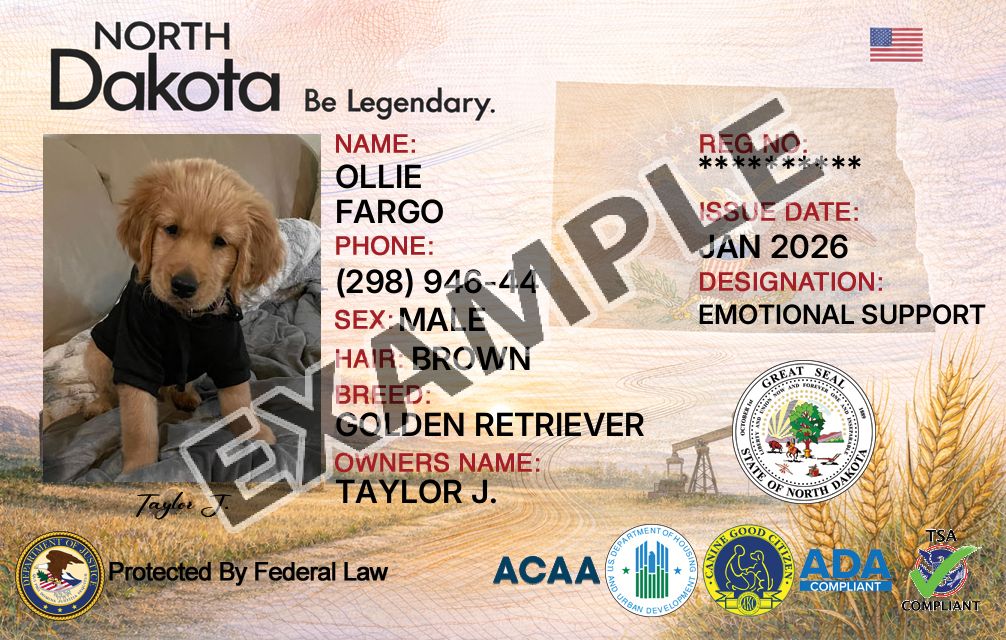
Select your county below to get started with your dog’s ID card. Requirements and license designs may vary by county, so choose your location to see the correct options and complete your pup’s registration.
- Adams County Dog Registration
- Barnes County Dog Registration
- Benson County Dog Registration
- Bottineau County Dog Registration
- Bowman County Dog Registration
- Burke County Dog Registration
- Burleigh County Dog Registration
- Cass County Dog Registration
- Cavalier County Dog Registration
- Dickey County Dog Registration
- Divide County Dog Registration
- Dunn County Dog Registration
- Eddy County Dog Registration
- Emmons County Dog Registration
- Foster County Dog Registration
- Golden Valley County Dog Registration
- Grand Forks County Dog Registration
- Grant County Dog Registration
- Griggs County Dog Registration
- Hettinger County Dog Registration
- Kidder County Dog Registration
- LaMoure County Dog Registration
- Logan County Dog Registration
- McHenry County Dog Registration
- McIntosh County Dog Registration
- McKenzie County Dog Registration
- McLean County Dog Registration
- Mercer County Dog Registration
- Morton County Dog Registration
- Mountrail County Dog Registration
- Nelson County Dog Registration
- Oliver County Dog Registration
- Pembina County Dog Registration
- Pierce County Dog Registration
- Ramsey County Dog Registration
- Ransom County Dog Registration
- Renville County Dog Registration
- Richland County Dog Registration
- Rolette County Dog Registration
- Sargent County Dog Registration
- Sheridan County Dog Registration
- Sioux County Dog Registration
- Slope County Dog Registration
- Stark County Dog Registration
- Steele County Dog Registration
- Stutsman County Dog Registration
- Towner County Dog Registration
- Traill County Dog Registration
- Walsh County Dog Registration
- Ward County Dog Registration
- Wells County Dog Registration
- Williams County Dog Registration